
The Terpene Effect: Do Cannabis Aromatics Matter in Skincare?

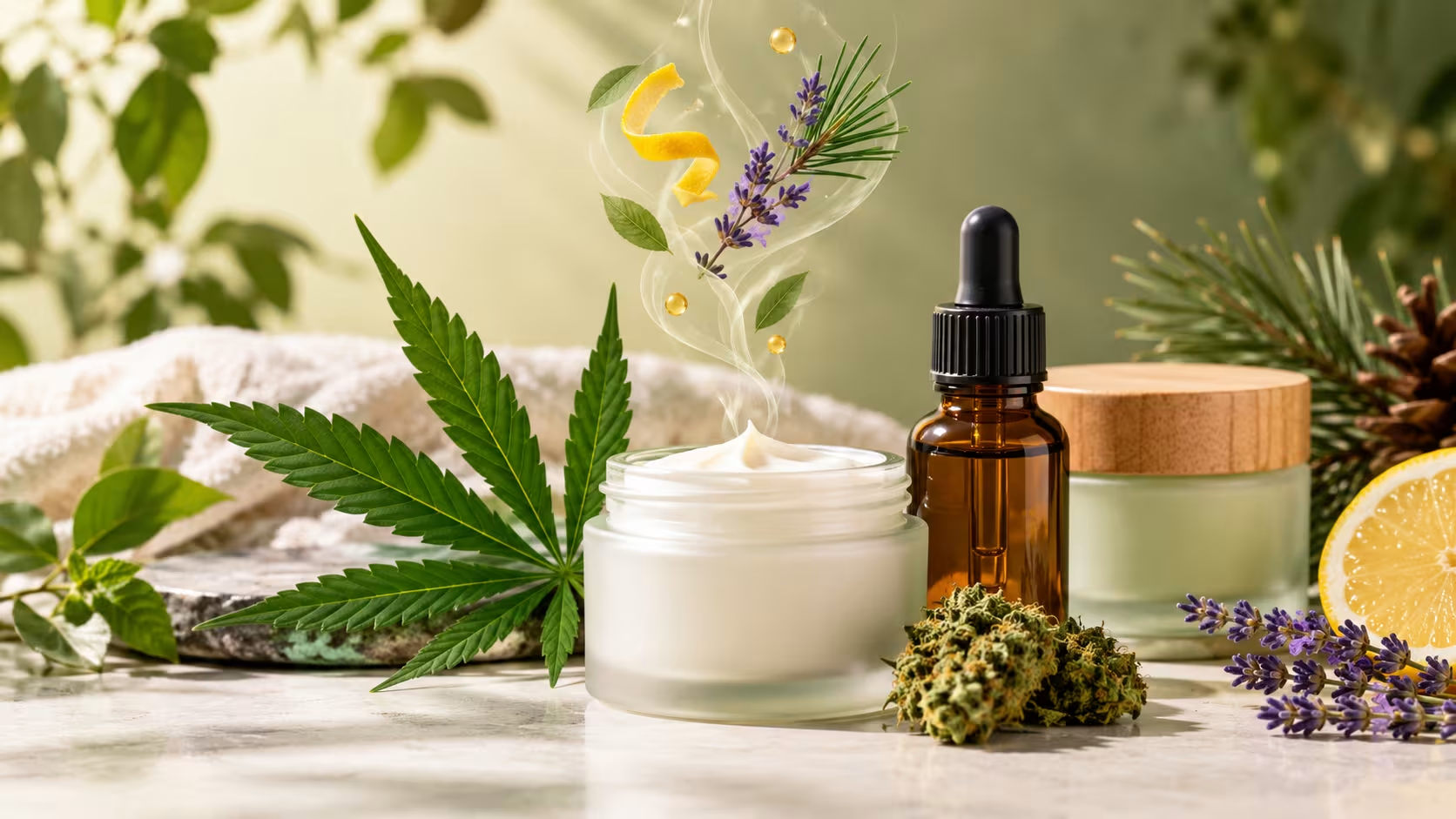
Cannabis terpenes are aromatic compounds that give cannabis and other plants their distinctive scents, from citrus and pine to floral and earthy notes. In skincare, terpenes may contribute to a product’s fragrance, but their presence does not automatically guarantee better results. Compounds such as myrcene, limonene, pinene, linalool, and beta-caryophyllene are being investigated for various biological properties, although more research is needed to establish their effectiveness in topical formulations. When choosing cannabis topicals, consider ingredient transparency, product formulation, and credible evidence rather than scent alone. Sensitive skin users should also be cautious, as certain fragrance ingredients may cause irritation or
Cannabis terpenes contribute to the plant's distinctive aromas. But when they appear in topical products, do they offer meaningful skincare benefits—or are they primarily part of the sensory experience? Here's what the science can and cannot tell us.

Cannabis skincare has grown beyond simple oils and balms. Today's topical formulations may combine cannabinoids, plant oils, fragrance, and aromatic compounds called terpenes. These compounds help give cannabis and many other plants their characteristic scents.
Their presence raises an interesting question: do cannabis terpenes make a topical product work better, or do they mainly affect how it smells and feels to use? The answer depends on the ingredient, formulation, concentration, and available evidence.
1. What Are Terpenes?
Terpenes are naturally occurring compounds found in many plants, including cannabis, citrus fruits, lavender, pine, and herbs. They contribute to familiar aromas such as citrus, wood, flowers, and fresh herbs.
In topical skincare, terpenes may come from botanical extracts, essential oils, fragrance ingredients, or cannabis-derived ingredients. Their presence and concentration depend on how the product is formulated.
Key takeaway: A terpene's presence in a plant does not automatically establish that it delivers a particular benefit when applied to human skin.
2. Common Cannabis Terpenes
These compounds are often discussed in relation to cannabis aroma. Their effects in a finished skincare product should not be assumed from aroma or laboratory findings alone.
| Terpene | Common Aroma | Skincare Context |
|---|---|---|
| Myrcene | Earthy, musky, herbal | Specific skincare benefits require direct evidence. |
| Limonene | Citrus, bright, fresh | Used in fragrance; oxidized ingredients may cause skin reactions. |
| Pinene | Pine, woody, crisp | May contribute to a botanical scent profile; benefits depend on evidence. |
| Linalool | Floral, lavender-like | Common in fragrance materials; oxidation products can be relevant to allergies. |
| Beta-caryophyllene | Peppery, woody, spicy | Investigated in research, but findings do not prove every product is effective. |
This is not a ranking of the most effective terpenes. It is an overview of commonly discussed compounds and why aroma, laboratory research, and proven consumer benefits must be distinguished.
3. What Does the Science Say?
Terpenes have been investigated in laboratory and preclinical studies for a range of biological activities. However, findings from isolated compounds do not necessarily translate into reliable benefits from a commercially available topical product.
To establish that a terpene improves a skincare outcome, researchers need appropriate studies involving the relevant ingredient, concentration, delivery system, and intended use. Evidence about one compound cannot automatically be applied to every cannabis extract or finished formulation.
What About the Entourage Effect?
The term “entourage effect” describes the possibility that compounds found in cannabis may interact with one another. It is a topic of scientific investigation, not a guarantee that a product containing cannabinoids and terpenes will be more effective.
More well-designed human research is needed to determine which combinations, if any, produce meaningful and reproducible effects in topical skincare.
4. Aroma Versus Skincare Benefits
Scent can influence whether a product feels pleasant to use. A fresh citrus aroma or soft herbal fragrance may make a skincare routine more enjoyable for some people.
But fragrance and efficacy are different things. A strong scent does not show that a product moisturizes better, calms irritation, or improves the skin barrier. A fragrance-free product can still be carefully formulated for its intended skincare use.
- Aroma: Describes how a product smells.
- Formulation: Describes how its ingredients are combined.
- Efficacy: Requires evidence that the product achieves its intended outcome.
- Tolerability: Describes how a person's skin responds to the product.
5. How to Choose Cannabis Topical Products
When comparing cannabis-infused balms, creams, and lotions, consider more than the terpene profile or scent on the label.
- Read the ingredient list. Look for fragrance ingredients that may not suit your skin.
- Check the intended use. Cosmetic moisturization claims differ from medical treatment claims.
- Look for transparent labeling. Clear ingredient information supports informed comparisons.
- Consider skin sensitivity. Fragrance-free options may be preferable if scented products have irritated your skin.
- Question bold claims. A terpene list alone does not prove clinical effectiveness.
6. Safety and Skin Sensitivity
Naturally derived ingredients can still cause irritation or allergic reactions. Some fragrance ingredients, including certain terpene oxidation products, are relevant to contact allergy.
Avoid applying concentrated essential oils or fragrance ingredients directly to skin unless appropriately formulated for that use. Follow product directions, and stop using a product if irritation develops.
A small-area patch test may help identify an immediate reaction, but it cannot guarantee that a product will never cause an allergy. Seek professional medical advice for persistent or severe symptoms.
7. Frequently Asked Questions
Do cannabis terpenes make skincare more effective?
Not necessarily. Their effects depend on the compound, concentration, formulation, and intended outcome. Their presence alone is not proof of better skincare results.
Are terpene-rich products better because they smell stronger?
No. Scent strength is not a reliable measure of efficacy, ingredient quality, or skin compatibility.
Can terpenes irritate sensitive skin?
Yes. Fragrance ingredients may irritate some people or trigger allergic contact dermatitis. Consider fragrance-free options if you are sensitive to scented products.
Are cannabis terpenes the same as cannabinoids?
No. Terpenes are aromatic compounds, while cannabinoids are a different group of compounds found in cannabis. Products may contain either group or both.
What matters most when choosing a cannabis topical?
Consider the full ingredient list, product quality, labeling, intended use, your skin's sensitivity, and credible evidence for the claims being made.
Further Reading
These resources provide background information and are starting points for further research, not direct proof of any particular cannabis topical's effectiveness.